Short Introduction
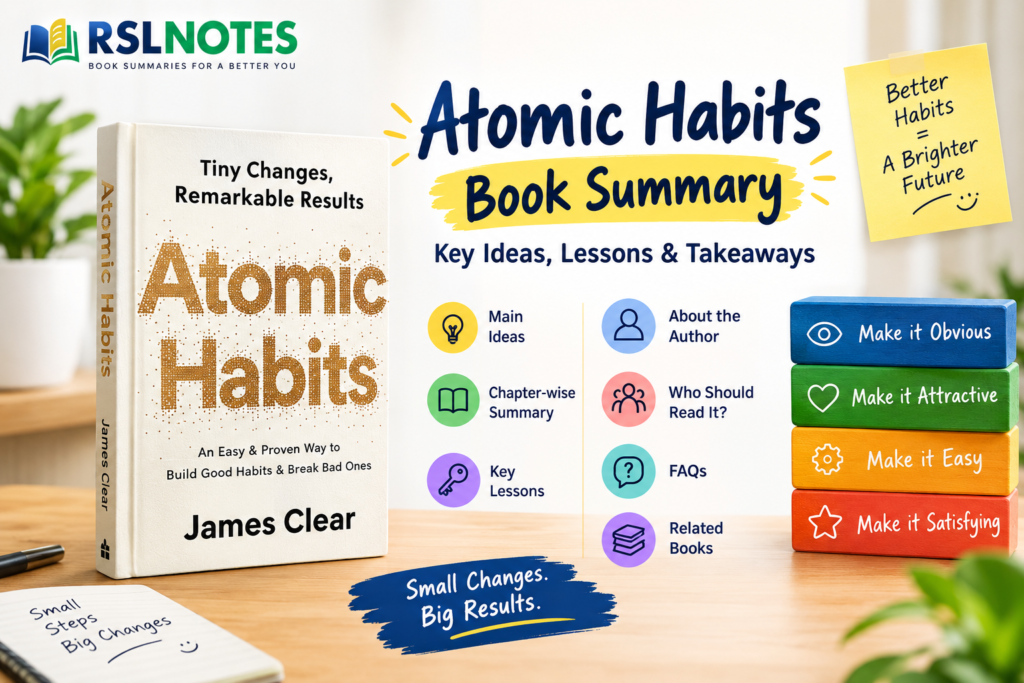
Atomic Habits by James Clear is one of the most popular books about habits, personal development, and behavioral change. The central idea of the book is simple: small improvements, repeated consistently, can create remarkable results over time.
Instead of depending on motivation or trying to completely transform your life overnight, James Clear explains how tiny changes in your daily behavior can gradually produce major improvements.
The book provides a practical framework for building good habits, breaking bad ones, and creating an environment where positive behaviors become easier to maintain.
About the Author: James Clear
James Clear is an American author, speaker, and writer known for his work on habits, decision-making, and continuous improvement.His ideas focus on how small behavioral changes can compound over time. Before publishing Atomic Habits, Clear built an online audience through his writing about habits, productivity, and personal development.
Atomic Habits was published in 2018 and became a major bestseller, making Clear one of the well-known contemporary writers on habit formation.
Atomic Habits Chapter-Wise / Section-Wise Summary
Rather than simply summarizing every chapter separately, the book can be understood through its major ideas and the Four Laws of Behavior Change.
Part 1: The Surprising Power of Small Habits
James Clear begins by explaining why small habits matter.A tiny improvement may seem insignificant on a single day, but repeated improvements can compound over months and years. In the same way, small negative habits can gradually create unwanted results.
The important lesson is that progress does not always appear immediately. Consistency allows small actions to accumulate.
Part 2: How Your Habits Shape Your Identity
One of the book’s most important ideas is the difference between goals and identity.Instead of focusing only on what you want to achieve, Clear suggests thinking about the type of person you want to become.
For example:
Instead of saying, “I want to read 20 books,” think, “I am a reader.”
Instead of saying, “I want to exercise,” think, “I am someone who takes care of my health.”
When habits become connected to your identity, they become part of how you see yourself.
Part 3: The Four Laws of Behavior Change
Clear introduces four principles for creating better habits:
1.Make it obvious
2.Make it attractive
3.Make it easy
4.Make it satisfying
These laws provide a practical system for changing everyday behavior.
Make It Obvious
The first step is to make your desired habit visible and clear.One useful technique is to decide when and where you will perform a habit.
For example: “After breakfast, I will read for 10 minutes.”
You can also use your surroundings to remind you of the behavior.If you want to read more, keeping a book somewhere visible can make reading easier to remember.
Habit Stacking
Another technique is habit stacking. You connect a new habit to something you already do.
For example: After I brush my teeth, I will read for five minutes.
The existing habit becomes a reminder for the new one.
Make It Attractive
The second law focuses on making habits appealing.People are naturally more likely to repeat behaviors they find rewarding or enjoyable.One strategy is to combine something you need to do with something you want to do.
For example, you could listen to an interesting podcast while walking or exercising.
Your environment and the people around you can also influence your habits. Spending time with people who have positive habits can make those behaviors feel more normal.
Make It Easy
Clear argues that reducing friction can make habits easier to maintain.If a habit requires too many steps, you are more likely to avoid it.This is why the Two-Minute Rule is useful: start by making a habit extremely easy to begin.
Instead of: “I will study for two hours every day.”
Start with: “I will study for two minutes.”
The goal is to establish the habit of starting. Once the behavior becomes automatic, it can gradually expand.
Make It Satisfying
The fourth law explains why immediate rewards can help reinforce habits.When an action feels satisfying, you are more likely to repeat it.Tracking habits can provide a visible sense of progress. Checking off completed tasks or maintaining a habit streak can encourage consistency.
However, missing one day does not mean you have failed. The important principle is to return to the habit instead of allowing one missed day to become a pattern.
Main Ideas in Atomic Habits
Small Changes Create Big Results
You don’t need to make dramatic changes immediately. Small improvements repeated consistently can eventually produce significant results.
Focus on Systems, Not Just Goals
Goals describe what you want to achieve, while systems describe what you do regularly to get there.Building a strong system makes progress more sustainable
Identity Drives Behavior
The habits you repeatedly practice can reinforce the kind of person you believe yourself to be.
Environment Matters
Your surroundings can influence your behavior. Making good habits visible and convenient can increase the chances of performing them.
Consistency Is More Important Than Perfection
A habit doesn’t need to be performed perfectly every time. What matters is returning to it and maintaining the overall pattern.
Key Lessons from Atomic Habits
Here are some of the biggest lessons readers can take from the book:
Small improvements can compound over time.
Build habits around the person you want to become.
Focus on systems instead of relying only on goals.
Make good habits obvious and easy.
Make bad habits less attractive and harder to perform.
Your environment can influence your behavior.
Start with small actions instead of waiting for motivation.
Consistency matters more than occasional intense effort.
Don’t let one mistake turn into a repeated pattern.
Long-term change comes from repeated daily actions.
Who Should Read Atomic Habits?
Atomic Habits can be useful for people who want to improve their everyday routines.It may be especially helpful for:
Students trying to develop better study routines
People who want to become more organized
Readers interested in personal development
People trying to improve their productivity
Anyone struggling with consistency
People who want to build positive routines
Readers interested in psychology and behavior
Anyone looking for practical self-improvement ideas
The book is particularly useful if you prefer practical strategies rather than purely motivational advice.
Frequently Asked Questions
What is Atomic Habits about?
Atomic Habits is about how small, consistent behavioral changes can lead to significant long-term results. James Clear presents a framework for creating good habits and reducing bad ones.
Who wrote Atomic Habits?
Atomic Habits was written by James Clear and published in 2018.
What are the Four Laws of Atomic Habits?
The Four Laws are:
Make it obvious. Make it attractive. Make it easy. Make it satisfying.
What is the main message of Atomic Habits?
The main message is that small habits, when repeated consistently, can create significant changes over time.
What is the Two-Minute Rule?
The Two-Minute Rule suggests starting a new habit with an action that takes approximately two minutes or less. The purpose is to make starting the behavior easy.
Is Atomic Habits good for beginners?
Yes. The book presents habit-building concepts in a practical and accessible way, making it suitable for people who are new to personal development.
Related Books You May Like
If you enjoyed Atomic Habits, you may also be interested in:
The Power of Habit — Charles Duhigg
Deep Work — Cal Newport
The 7 Habits of Highly Effective People — Stephen R. Covey
The Psychology of Money — Morgan Housel
Think and Grow Rich — Napoleon Hill
Rich Dad Poor Dad — Robert Kiyosaki
The Midnight Library — Matt Haig